I Remembered, Then, That I Am a Woman
On being seen as a woman first and an engineer second

I forget, occasionally, that I am a woman.
I forget that my team and org at work are comprised almost entirely of men. I move through our projects the same way I move through any hard problem that captivates me—with focus, with curiosity, and with everything I have. And I forget the specifics of our identities while I collaborate with my teammates to solve the problems that we encounter every day.
And then something happens, and I remember.
My team was in Miami for an offsite recently. We had picked out a small seaside restaurant for our team dinner towards the tail end of the trip. Upon our entry, we were whisked away from the main dining room and ushered into a quieter room with a long table. Half of the seating involved normal chairs, and the other half was a booth running along the wall.
I love a booth.
And so did one of my teammates, apparently. He—I'll call him Akshay—was the first to sit, and he beelined for the booth, settling into the center. And I, also wanting a booth seat and also not wanting to be the jerk who perched at the edge of the booth, forcing everyone to awkwardly shuffle past me, slid down the booth and sat down next to Akshay.
And then he slid over. Deliberately. A small, clean movement that put a seat between us.
And I remembered, then, that I am a woman.
I am a woman, and Akshay is a man. And to a significant number of the people I will work alongside, that ordering matters more than anything else I might bring into a room.
I noticed that evening that Akshay didn't bat an eye when a male colleague sat down right next to him. He started talking with the people around him, floating the idea of sharing plates, pulling everyone into the fold. Everyone but me.
I pretended to study the menu, and I thought about how he has told me, repeatedly, that I work fast. That my instincts are good. That I'm smart. But even despite all of that, he still couldn't treat me the same as the men around me.
Not everyone reacts this way to me, of course. A different male colleague had moved into the spot next to me without a second thought and struck up a conversation immediately. Another pulled me into the plate-sharing discussion when Akshay had let it pass me by. They didn't make it a thing. They just included me, the way you include a colleague, because that's what I am.
Still, I felt a deep sadness during that dinner.
I felt grief for something I had hoped for since starting to work in this industry: that if I worked hard enough, earned enough, proved enough, I would eventually get to just be an engineer. That the modifier would fall away. That I would stop being a woman engineer and become, instead, an engineer who happened to be a woman—a distinction that sounds subtle but isn’t in practice, because there is a hidden pink tax in this industry. Being a woman engineer instead of just an engineer costs something here.
It wasn't always like this.
I started competing in a global robotics program when I was in elementary school. And by the time I started high school, I was leading a team of my own.
As surprising as this may sound, the robotics social scene is a wildly cut-throat, male-dominated community that stretches across the globe. But I, with my gregarious nature, didn't mind and joined the community with the intention of befriending everyone that I could talk to.
The issue is that my team wasn't particularly good at the start, which apparently gave a number of people permission to begin disparaging us. And for months, I used to wake up to DMs from boys who wanted to inform me, with utmost urgency, that women didn't belong in engineering. That my team wasn't going to amount to anything. That we should just quit!
The hostility was not subtle because it didn't need to be—I was a teenage girl in a space that had decided, ahead of my arrival, what I was and wasn't going to be capable of.
But I was determined. I laughed in the face of adversity. Instead of shrinking away, I leaned into my femininity. I wore face paint to competitions and put sparkles in my hair. I decorated the sides of my safety glasses with washi tape and rhinestones, and I handed out beaded necklaces to my competitors. And I did it all with a smile.
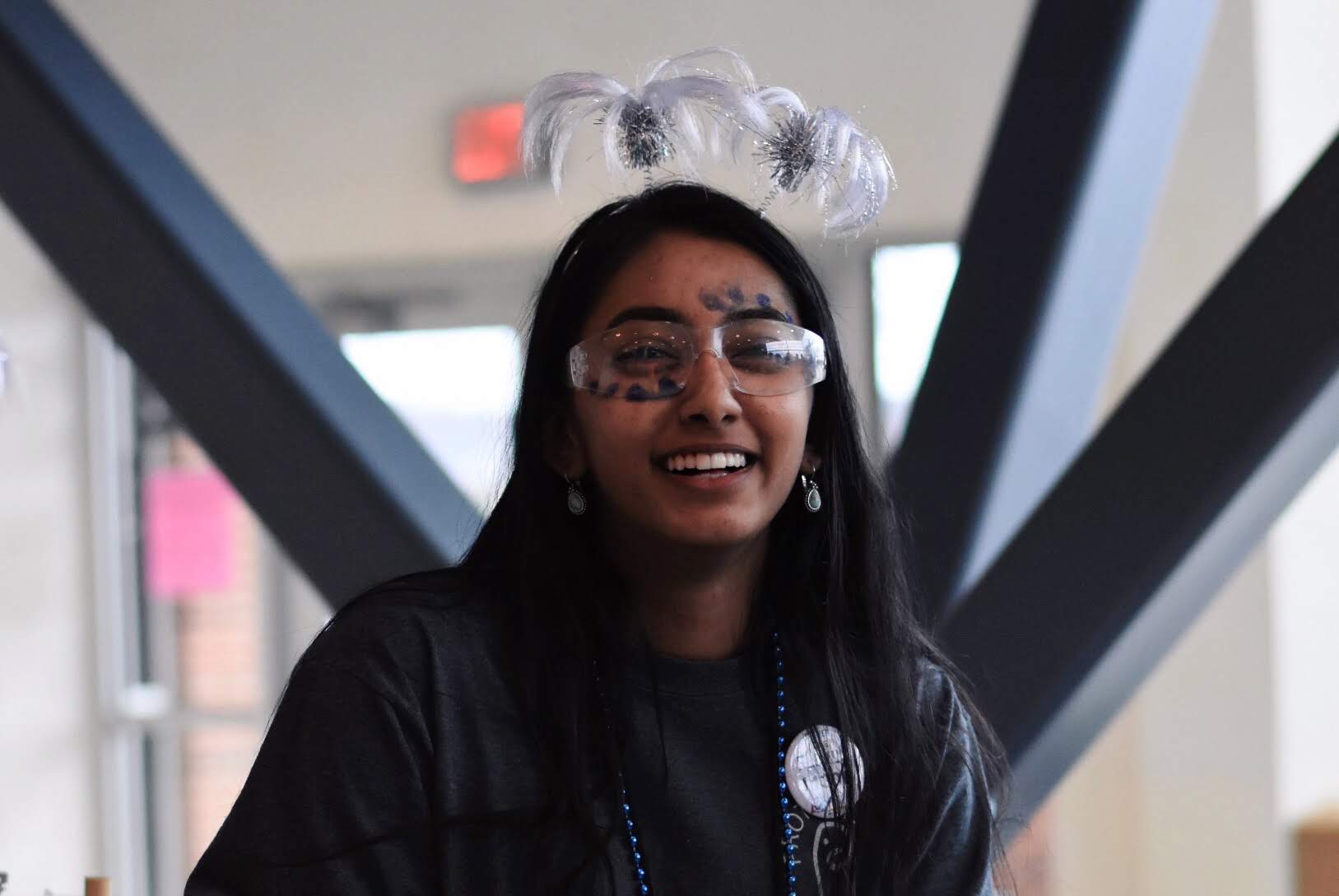
I was girly—very, very girly—in a space that kept trying to convince me that being a girl was a liability I could never overcome.
I refused to treat it as one.
I shielded my teammates, especially the younger ones, from the commentary so they could focus on their work and find their love for engineering in a safe space. I showed the girls on my team that there was room for them exactly as they were—that you could be as kind and playful and feminine as you wanted, and you could also be very, very good at what you do.
The contrast was intentional. I wanted it to be visible.
Over time, our team improved. We got good. Really good. We started winning—consistently, against teams that had written us off before we'd built anything. Our competitors had no choice but to now fear the girls with the sparkles and face paint.
I ended up double-qualifying for the world championship during my last full season in the competition, and one of the teams I was competing on that year won. My face was plastered on jumbotrons, banners, and pamphlets that were used to promote the competition on the global stage. I met the founders of the program, found life-long mentors, and made lasting friendships with some of the world’s brightest engineers in the making.
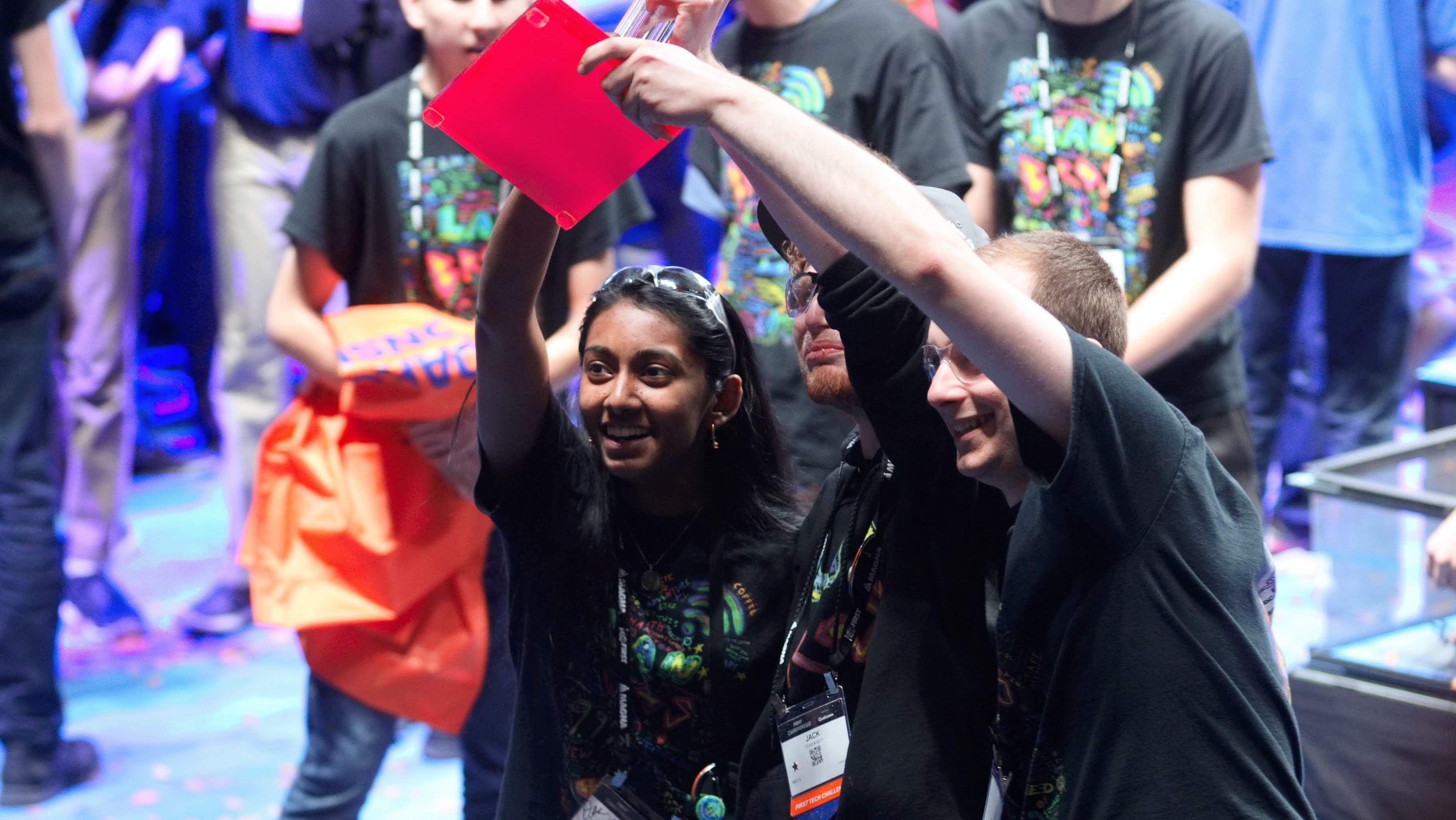
I successfully brute-forced respect.
I thought the winning was the proof. I believed that if I showed up fully and then outperformed everyone in the room, the point would land. That any assumptions of ineptitude would become untenable, and that enough women doing this for long enough would eventually shift the tide.
I eventually graduated out of the program, and I left a community that looked a little more like what it should have been when I first found it.
The boys who messaged me in high school were immature. I gave the world the benefit of the doubt. I hoped that they would grow out of it and that the next version of this—adult professional life, senior engineering teams, serious technical work—would be different. Not perfect, but meaningfully different.
Then a man slid away from me at a booth in Miami, and I understood that it wouldn’t be so easy.
I am currently the youngest member of an extremely talent-dense engineering team. My teammates have PhDs, countless patents, and degrees from the best computer science programs in the world. They have decades of experience. Some have been working longer than I have been alive.
I know what I know, and I know what I don't. And I do not try to obscure the limits of my knowledge. The gap in the level of experience between my teammates and me is real, and I respect it. And I am working to close it.
But I know that I am here for a reason. I was recruited four times to work as a researcher at the best engineering school in the world. I studied computer science at and graduated with Latin honors from an Ivy League institution. I went through a rigorous interview process—technical and nontechnical—to get this job. I was scrutinized at every stage. And a team of people looked at everything I had built and decided I belonged here. I know my work. I am not confused about my own competence.
And yet, the bias finds a way. No one sends me hostile messages anymore—thank god for HR—but the attitude finds other channels. Competence, I am learning, is not always the only variable being evaluated.
So I have adapted.
I don't share personal details at work. My teammates know my work, but they don't know much else. No one knows about my weekend plans or what I did last night. I don't talk about my relationships. I don't let the full shape of my life become visible, because I know what happens when it does. I have seen the math run on other women in real time. The assumption is that a woman with a personal life is a woman with divided attention. That engagement, marriage, and children are liabilities waiting to surface. That the fuller her life looks outside of work, the less seriously she can be taken inside of it.
No one says this out loud, but the calculation runs regardless, and I have decided, very deliberately, not to give it anything to work with. I have become an enigma. I am present and engaged and somehow also opaque, a person who takes up space technically and almost none personally.
I grow frustrated when I reflect on the fact that I arrived at this strategy not through paranoia but through observation.
But then I think about the women who came before me.
My grandmother was one of the first women admitted to her engineering college. There was no restroom for her. Because no one had thought to account for her existence in that building. But she studied engineering anyway. She was never going to be invisible—her presence in those halls announced itself whether she wanted it to or not. She had no choice but to be seen as a woman first. She excelled anyway. She has countless patents to her name, and she was a powerful force in the engineering community through the span of her career.
My mother is an engineer too. She knows complex systems in and out—the kind of depth that takes decades to build and is immediately apparent to anyone who works with her. She is a mentor. She teaches concepts with a clarity that makes difficult things feel inevitable in retrospect. She is extremely opinionated, and her opinions are usually sound, and she will tell you why until you understand. She questions everything—requirements, assumptions, the way things have always been done. She learns constantly. She is, on every team she has ever joined, a well-respected member of it. And she has never made herself opaque. She talks about her hobbies. She talks about her kids. She used to see her colleagues outside of work.
I don't think either of them had the option to be particularly enigmatic. They were visible by necessity—unmistakably women in spaces that, at the time they started working, had not prepared for them—and they built legacies anyway. They just kept going, and they were so good, and so present, and so entirely themselves, that the room had to reorganize around them.
I come from that. And I was raised to know it.
My father is probably one of the smartest engineers I know. He works in a space—quantitative finance—that has even fewer women than the one I'm in. He's cognizant of the gender gap in the industry. He reflects on it. And then he pushes me anyway. If being an engineer is what I want, then I can do it. I should do it. Just be really good. That's all that has ever mattered to my parents—my talent.
He praises my mother in conversations when she isn't even in the room. He tells me about how technically strong she is, how sharp, how hard-working, how rigorous. He talks about my grandmother the same way. He raised me to love engineering, to respect those who are good at it, and most importantly, to own my intelligence.
I was raised by a family who taught me to hold my ground. Who showed me, by example, that the dichotomy I was forcing the robotics world to accept was never a dichotomy at all. That being a woman and being an exceptional engineer were not two things in tension. They were just two things that were both true.
I am not just technically capable. I am sociable. I am warm. My energy is intense, and my geniality is genuine, and these things do not cancel each other out—they coexist, and they always have.
I was the girl with the teal eyeliner who forced an entire community to hold the full version of her. It worked. And then I stepped into the professional world and quietly took that version of myself apart, piece by piece, in the name of strategy and self-protection.
I want to pick her back up. Not naively—I know the room, and I know its rules, and I am not confused about what I'm walking into. But I want to be seen as a woman. I want to bring my charisma and my warmth and my intensity into the workplace. And I want people to take me seriously—not in spite of who I am, but alongside it.