Kindness Embodied
An old profile I wrote on a good friend.
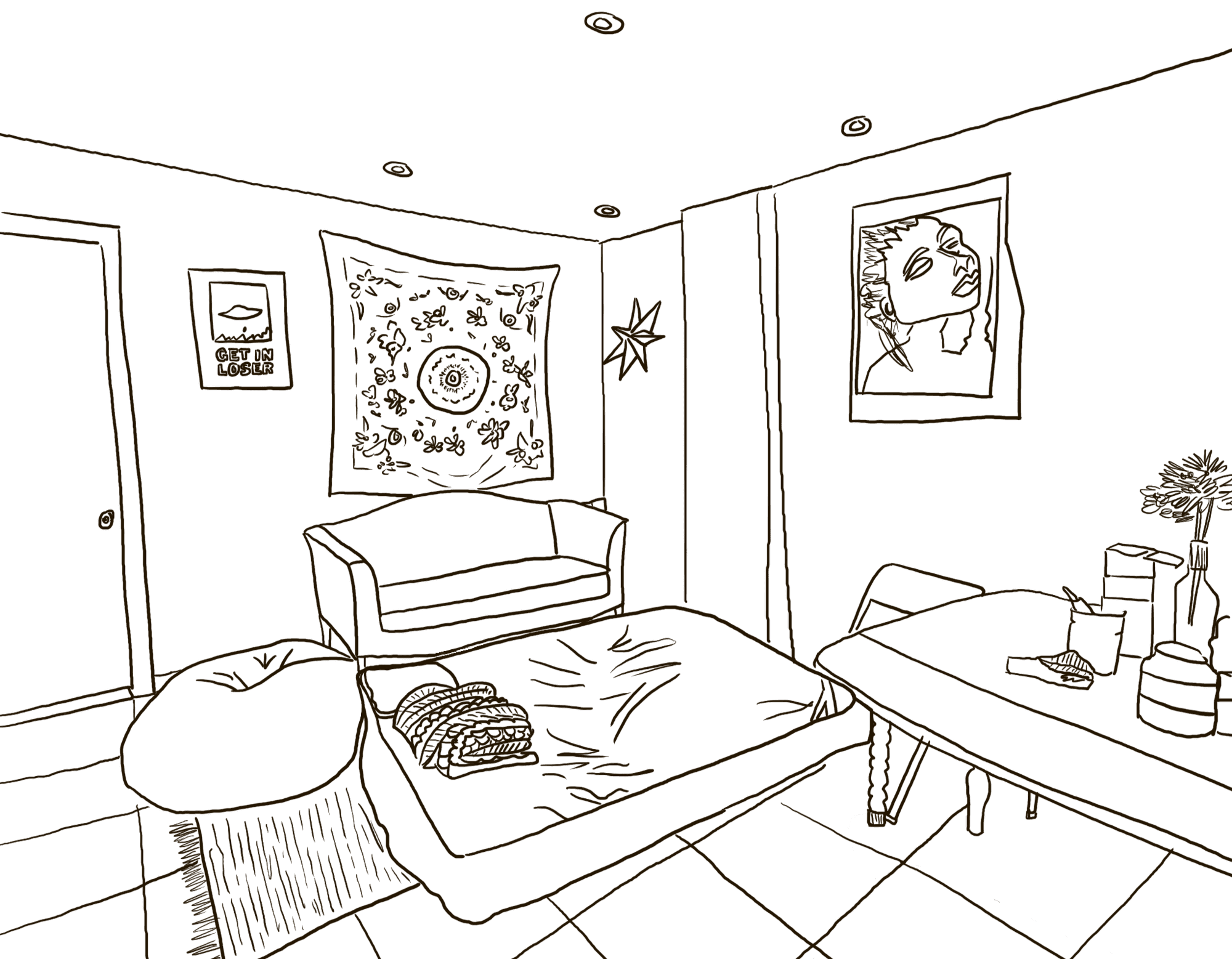
I drew our college living room
Naomi is a gem.
She has an infinite supply of books, coats, and research papers (and she has read them all).
She prefers her rooms dimly lit—the light of a single candle is often enough—and a bit cold. And on occasion, you’ll find her in the living room, standing on her hands.
Naomi is the kind of person that radiates warmth and intelligence with every fiber of her being. I’m convinced that I could listen to her talk, think out loud, theorize about the world forever, and I would never get bored.
She often talks of shaving her head and traveling the world. She wants to leave everything behind for a simple life in the mountains. Or maybe the woods. Or maybe she’ll stay in the city.
I grow impatient while wondering what Naomi will be like in 30 years. Where will she be living? How many places will she have seen? What sort of wisdom will she be able to impart on me then?
I have many questions for middle-aged Naomi.
And while I wait to meet her, I’ve compiled a list of some things I have picked up from the Naomi I know now:
“I’m so sorry that that happened to you”
I have a habit of joking about my about my experiences in a pressure cooker high school with new friends. It’s an exchange that often marks the start of a meaningful relationship: I offer a piece of trauma from my past, neatly packaged in a joke, and the other person reciprocates, sharing a dark story of their own.
One evening, shortly after I had moved into our apartment, my roommates and I found ourselves slumped across the large, white marble tiles of our living room floor, overcome by the late-August heat. We were working on getting to know each other—the people we had contractually committed to living with for a year—when I started the exchange of secrets with Naomi.
I began with my half, making wide eyes and chuckling at the ridiculousness of the whole story, and then waited for Naomi’s bit.
But instead of sharing an anecdote of her own, she looked at me, earnestly, and said, “I’m so sorry that that happened to you.”
I was taken aback. This wasn’t part of the script.
After a brief pause, I brushed it off with a laugh. It was nothing! It was just a silly story that was meant to make us laugh! And I changed the topic.
But her reaction stuck with me long after the conversation had ended.
I was moved by the sincerity of her concern. And over the next few months, I grew to recognize that this wasn’t a unique occurrence—it was just in her nature to be deeply compassionate and solicitous in her every interaction. Her deliberate displays of empathy make every conversation comforting; she has an innate ability to make everyone around her feel heard and understood.
Naomi, through this exchange and hundreds just like it, taught me the power in explicitly expressing empathy.
“Lightly child, lightly”
“What does the back of your shirt say?” I asked Naomi this question while sprawled across the floor-bed (we have a mattress on our living room floor for reasons that neither of us can fully articulate. It sits directly in front of our couch). My question was an imprecise one—I knew that Naomi had written the phrase “lightly, lightly” on the back of the shirt in bleach; I was curious about what it meant.
Luckily, Naomi always knows what I mean, even when the words don’t come out quite right.
She told me it was a quote from Aldous Huxley, and she read me the poem that she had pulled the phrase from:
It’s dark because you are trying too hard.
Lightly child, lightly. Learn to do everything lightly.
Yes, feel lightly even though you’re feeling deeply.
Just lightly let things happen and lightly cope with them.
I was so preposterously serious in those days, such a humorless little prig.
Lightly, lightly – it’s the best advice ever given me.
When it comes to dying even. Nothing ponderous, or portentous, or emphatic.
No rhetoric, no tremolos,
no self conscious persona putting on its celebrated imitation of Christ or Little Nell.
And of course, no theology, no metaphysics.
Just the fact of dying and the fact of the clear light.
So throw away your baggage and go forward.
There are quicksands all about you, sucking at your feet,
trying to suck you down into fear and self-pity and despair.
That’s why you must walk so lightly.
Lightly my darling,
on tiptoes and no luggage,
not even a sponge bag,
completely unencumbered.
I had heard this poem before this interaction; I’m certain of this. But this was the first time I heard what Huxley was saying.
I struggle with taking everything too seriously and taking everything to heart. I feel things too deeply, and I push myself too hard.
I am constantly in the pursuit of absolute perfection in everything that is meaningful to me.
And I only became aware of how unhappy I could make myself by acting this way recently.
I was once told that stoicism, the practice of focusing on the things within my control and accepting the things outside of my control, would bring me peace. But I struggled to adopt this school of thought because I couldn’t discern the bounds of what I can and cannot control. And moreover, I repeatedly found myself preoccupied with the idea of being an incredibly successful stoic, which defeated the purpose of the undertaking entirely.
Perhaps walking lightly would bring me a step closer to my goals.
“We’re just organisms.”
This is one of my favorite quotes of hers.
It’s something that she repeats every few weeks.
We’re just organisms, and we each have a hierarchy of needs.
Naomi’s looks something like this:
- Movement
- Water
- Food
- Sunlight
- Friends
- Sex
“We’re just organisms!” She’ll say when one of her friends is being overly critical of their body. Or when one of us adds a tally mark to the “Days since our unit has seen the sun” whiteboard on the fridge, making a comment about how the lack of exposure to sunlight is beginning to affect their mental wellbeing.
I’m just an organism, I’ve started telling myself when my mind starts racing, and I feel an anxious pit forming in my stomach.
It serves as a constant reminder that we are nothing more than particularly evolved organisms that happened to have opposable thumbs and sufficient brain matter to make to-do lists and grand conjectures about the world and our place within it.
I’m just an organism, and nothing more. And I feel a deep sense of comfort in reminding myself of that.
“Time is fake! All of our moments together last for eternity!”
We have a timekeeper in our apartment.
Her name is Claire, and she has started punctuating the silence in our home with announcements to alert us of the passage of time.
“We only have two weeks until we’re done with college!” she’d shout, her head sticking out of the narrow gap she left between her door and doorframe.
Someone in the apartment would groan in response. All of us would reflect, briefly. And then we would continue on with our days, each of our hearts a little heavier.
Once, while Naomi was on her way out of the apartment, Claire after reminded us that “we only have four months left together!”
This time, Naomi spun on her heels and shouted, “Time is fake! All of our moments together last for eternity!” in a sing-songy voice before closing the door behind her.
Her words hung in the air long after she left.
I found myself smiling at the hallway she had walked through, making a mental note to cherish our remaining days together.
Time may be passing, but a part of me will still live in this shoebox with these three girls forever.