Dan Whitesmith
Here are some lessons that I’ve picked up from Daniel Whitesmith, someone who I agreed to have dinner with on a whim.

Bogdan Farca via Unsplash
Here are some lessons that I’ve picked up from Daniel Whitesmith, someone who I agreed to have dinner with on a whim.
Had my social battery been at its basal state that evening (as it is on most weekday evenings), I would likely have gone my entire life without meeting him.
Our entanglement, in my mind, is a testament to the beauty in making conversation with a stranger over a plate of rigatoni alla vodka and later, a Moscow mule. It is evidence of the charm in sharing pieces of ourselves with other people and slowly stumbling outside the bounds of “strangers” and into something else entirely. It is a reminder to myself that I really should leave the house more.
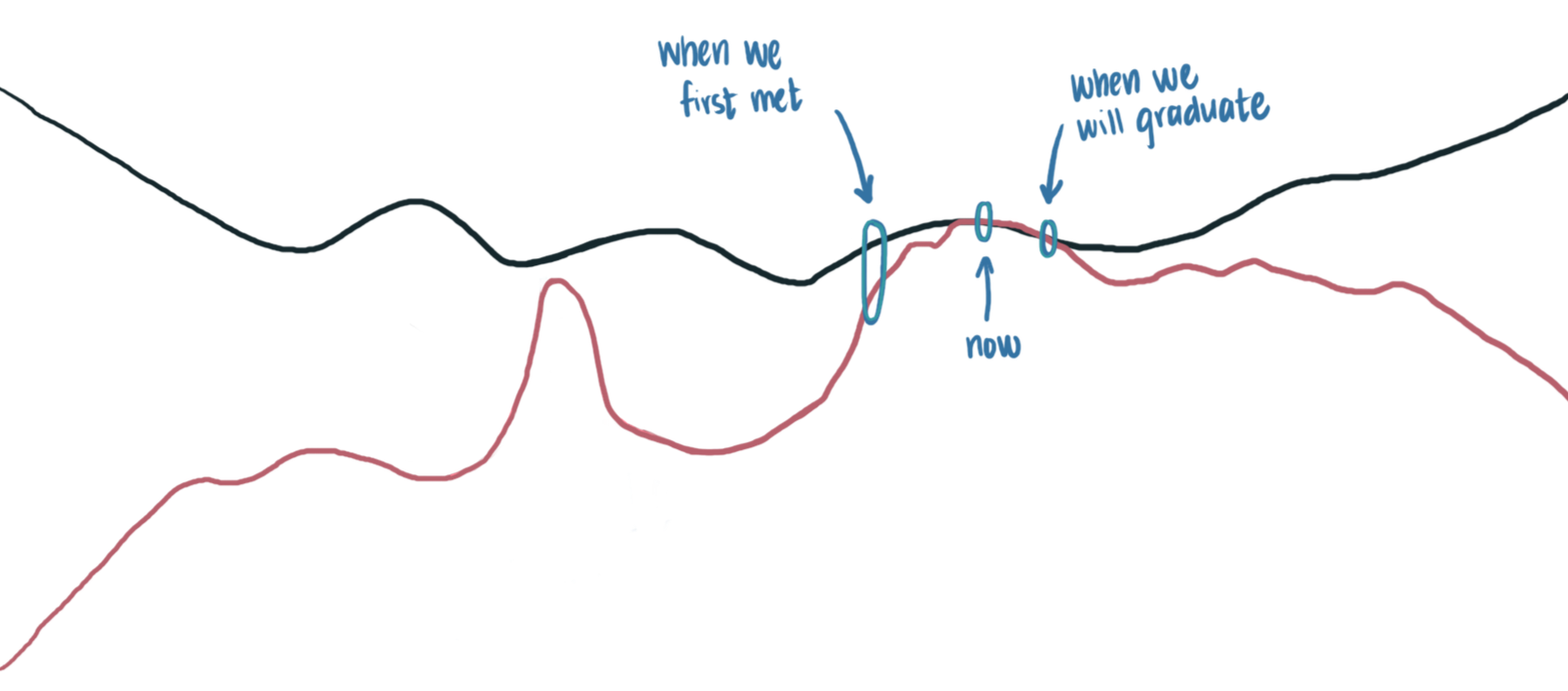
Now I’m not sure how long Dan and I will be in contact. But if I could visualize my assumptions and expectations of our propinquity using closeness lines, it would look something like this:
You don’t always need to agree with your friends.
Dan and I have irreconcilable differences. We know this.
We cannot come to a single consensus on religion, spirituality, geopolitics, or (possibly most troublesome of all) what to eat for lunch.
Every time I coax an opinion out of Dan, I am enraged by it. How can someone think like this?
Yet it’s invigorating.
My Thursday evenings now often involve shoveling a small spoonful of chocolate ice cream (Ben and Jerry’s Chocolate Fudge Brownie) into my mouth, sliding its pint-sized container to Dan, and asking “What do you mean you don’t think that humans are just animals? How can you be so self-centered? Why do you need us to be special?”
Dan usually takes the pint, rolls his eyes, and articulates an answer that seems to be vaguely influenced by his religious upbringing before popping the spoon in his mouth.
I’m never satisfied by his answers, so I push him with more questions, shaking my head in disagreement and allowing the fire in my chest grow stronger with each one of his outrageous answers.
We will simply never agree.
That is one of the few things that we can agree on.
An alternate understanding of the nature of suffering.
“If you had an ‘antidote’ that could end a person’s perception of suffering, would you give it to them?”
Dan’s face contorted as though I had asked him something that offended him. I expected him to begin discussing the moral implications of the so-called antidote and start with an answer that was unquestionably anchored in his Christian foundations. Instead, his mind wandered in a different direction.
The thing about happiness, Dan argued, is that it necessitates suffering.
Suffering, in his mind, provides contrast, context, and meaning to moments of joy and fulfillment. Without suffering, a person cannot experience bliss.
I mulled over this. Despite the beauty in his response, it felt inordinately philosophical.
I subscribe to theories like functionalism and the computational theory of mind. Functionalism argues that mental states are defined not by their internal composition but by their roles—how they interact with sensory inputs, other mental states, and behaviors. The computational theory of mind builds on this, suggesting that mental processes are akin to computational operations, leading to the idea that consciousness and thought could be emulated by computational systems.
Happiness, to me, is the result of chemical reactions in the brain.
And if this conjecture about the nature of happiness is true, then it can be felt without the presence of human suffering.
Though I don’t agree with Dan’s understanding of suffering, it was a beautiful thought to consider, even if it was only for a moment.
It is not necessary to live in absolutes.
When it comes to matters of social reform or global politics, Dan very rarely takes a side.
He lives in gray areas, existing solely in the indifferent spaces between opposing flanks in tense arguments. He intentionally treads the murky waters of ambiguity, refusing to commit to a single stance, even when the stakes are high.
It frustrates me when he maintains a cool air of apathy during discussions about world affairs.
“Pick a side! Agree with me or argue with me!” I want to tell him, indignantly. Nothing is ever clearly black or white, but I believe that there is virtue in having an opinion—in talking things out.
Dan passionately refuses to share his opinions on contentious topics, often responding to my remarks with blank stares and thoughtful silence. The most I could cajole out of the man are vague, neutral sentences—a whole lot of nothing. His commitment to silence led me to believe that he quietly disagreed with everything I said but was put off by my eagerness to defend my beliefs.
But yesterday, he sent me this image:
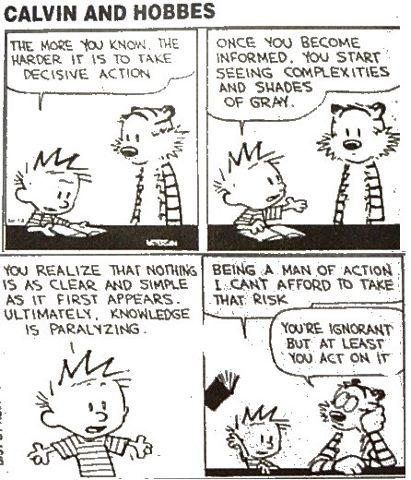
“Is this in response to my stances on geopolitics?” I asked him.
He did not look away from his problem set when he answered, “No,” but the corners of his lips betrayed him and curled upwards into a sly smile.
Visit small, local restaurants. Sometimes they have cats inside.
I’m convinced that Dan has visited every single deli and restaurant in our university’s periphery.
Though he swears he’s not a foodie, he takes delight in showing me his favorite spots for “a slice”, a chopped cheese (on a roll), and a banh mi.
Dan specializes in hole-in-the-wall restaurants with discreet signage, little to no seating, and short menus; it’s as though the places he finds pour all of their resources into making mouthwatering food, understanding that they need not invest in frills.
Their customers will come regardless.
Dan will come regardless.